ISRAEL 6
This is my last post from Israel; I'm heading home tonight, leaving Tel Aviv at midnight and arriving home late afternoon. It's always fun going west because you gain time instead of losing it. By the way, for the few who have used this platform to spread vitriol about my being here, be assured that if the Arab community asked me to come to encourage them, I would do so. I've never shied away from authentic seekers, regardless of their ethnicity or religion.
Today I did my last in-field pasture walk presentation on a farm not too far from the ancient city of Shiloh, where the Tabernacle stood for 369 years.
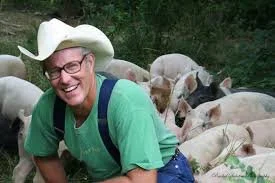
With this group of farmers, I learned about a new and increasing problem: wild boars. That has unique consequences in a nation that largely steers clear of pigs. These have only become a problem in the last 20 years. From my perspective, I don't see what they eat since the land is generally barren, but there are enough gardens, field edges, and orchard nut and fruit drops that the resourceful pig can survive. Professional hunters come to shoot them when a farmer calls in a problem. Due to lack of forest, the pigs don't have good hiding places like they do in other areas.
Dining on 8-year old beef cooked on a charcoal grill (it was delicious), I learned the Jews don't each much lamb. Most of the Israelis living here came from Europe and the U.S. where lamb is not a major meat. The top animal protein is chicken. That's the everyday meat and seldom eaten in restaurants. KFC has tried numerous times to gain a foothold here but so far has been unsuccessful because if you're going to dine out, you eat beef.
The first time I came, three years ago, my big takeaway was the rocks. It seemed nearly hopeless. But this time, I've met farmers conquering the rocks with pocket masonry drills for electric fence stakes and a can-do spirit to intensively manage their stock.
This time I have two big takeaways that I shared with the group in the field this afternoon. The first is stopping surface runoff. A corollary is slowing down water in the deep ravines. All over, deep gullies--really deep, like 50 feet--are everywhere. Why not take the rocks and place them in these gullies as a permeable dam to slow the water and drop all the silt on the uphill side?
We did that on our farm in the early days, not with rocks but more with tree branches shoved into the bottom of gullies. In no time, a little terrace developed on the uphill side because the water slowed down enough to drop its load of silt. Like many things, the goal is to achieve multiple functions with one action. They tell me that field preparation for vineyards costs about $10-12,000 per acre. Instead of just piling up the rocks on the edge of the field, placing them in the gullies would yield a second benefit from the action.
Worldwide, average surface runoff is 1/3 of all raindrops. They either come too fast at once or too much at a time for complete absorption. Surface runoff devastates the land through erosion and flooding. Here, the farmers say it is 50 percent. Slowing that needs to be objective number one.
The second big takeaway this time is more a strategic plan, and it applies everywhere. All week I've been receiving pushback (always with a smile) about the most difficult areas. I go on a farm with a beautiful green valley of 50-100 acres but after listening to my managed grazing ideas, the farmer points at his highest, farthest, most terrible spot and queries "what about that? What do you do there?"
Finally it came to me today after dealing with this for the umpteenth time. We were out in the field at the top of a beautiful green valley with hills, desolation, and rocks--did I mention the rocks?--all around. I pointed down the valley and said "develop the easy land first. Make it perfect and then work on the rest." I don't know why it took my all week to put this together, but we should always pick the easy fruit first.
We tend to imagine the most difficult aspect and demand an answer for it. What's the recipe for the hardest thing? Strategically, we need to develop the easiest first and let that finance the harder. I showed them how they could gross in $28,000 per acre with stacked enterprises on these easy acreages. That got their attention. For now, forget about the difficult parts. This is a great life lesson for all
When we're hearing a new idea, though, our tendency is to look at the most difficult aspects first. Then we're intimidated and we never make progress. These farmers really warmed up to the idea. Many left committed to do just that. I told them to never be ashamed of little projects. Nature scales by duplication, not consolidation.
The crowning joy was a lady who came up to me after I did my "May all your carrots grow long and straight . . . " blessing. She said "love from afar for us means more than you can imagine right now. You've brought love to us, and it's life changing." I wiped tears from my eyes. Shalom, Israel.